


 Français
 عربى
Product Consultation
Your email address will not be published. Required fields are marked *
A toughened panel that fails usually fails at a hole, a notch or a cut edge, and rarely in the middle of the sheet. That pattern explains most of what matters about glass toughening: it is a thermal treatment that locks permanent stress into the whole panel, and every machining step has to be finished before the glass enters the furnace, because nothing can be drilled, cut or polished afterwards.
Toughening — tempering, in American usage — heats annealed float glass to roughly 620–700°C and then quenches both faces with high-pressure air. The surfaces contract faster than the core, so the finished panel carries high compressive stress outside balanced by tensile stress inside. The outcome is a panel four to five times stronger than annealed glass of the same thickness, far better thermal shock resistance, and a fracture pattern of small blunt pieces rather than long sharp shards.
Content
Buyers sometimes treat "tempered" as a label on a sticker. It is not a grade; it is a measurable stress state, verified by test rather than by appearance.
The face of a toughened panel is robust; the edge is not. Edge damage of about 1 mm is enough to release the local stress balance and trigger a break that runs through the sheet. Edge quality, corner protection in packing and careful handling on site belong in the same conversation as the furnace itself.
The sequence is fixed, and most quality failures trace back to a step being rushed rather than to the furnace.
Occasionally a toughened panel breaks with no impact at all, sometimes months after installation. The usual cause is a nickel sulphide inclusion in the original float glass. The inclusion changes phase slowly at room temperature, expands, and eventually pushes the tensile core past its limit.
The countermeasure is the heat soak test: panels are held at about 290°C for a defined period so inclusions convert and the affected panels break in the factory instead of in a bathroom. EN 14179 defines the process. It is rarely mandatory for a domestic shower door, but worth specifying for large panels, dark printed glass in hot climates, and any project where replacement access is difficult.
| Parameter | Typical requirement | Why it matters |
|---|---|---|
| Thickness | 6, 8 or 10 mm, ±0.2 to ±0.3 mm | Hardware fit, panel weight and structural calculation |
| Bow and flatness | Maximum 0.3% of the shorter side | Frame closure, roller track alignment, seal contact |
| Hole position | ±1.5 to ±2 mm | Pivot and hinge alignment before the screws go in |
| Edge finish | Flat polished or arrised, no chip above 1 mm | Edge damage is the most common trigger for failure |
| Fragmentation | At least 40 particles per 50 × 50 mm | Evidence that the panel is genuinely toughened |
| Roller wave | About 0.3 mm over 300 mm | Visible distortion in reflections and printed glass |
| Heat soak | EN 14179 where specified | Reduces the risk of spontaneous nickel sulphide breakage |
Nearly every shower screen sold today is toughened, usually at 6 mm, 8 mm or 10 mm. Thickness is a weight decision as much as a strength one: glass weighs about 2.5 kg per square metre per millimetre, so a 900 × 2000 mm panel at 10 mm is roughly 45 kg hanging on two hinges or running on two rollers.
That load explains why the toughening specification and the hardware specification have to be agreed together. A hole pattern designed for a double-hole handle, a hinge spacing set for 8 mm glass, or a roller set rated for a lighter door will all cause problems that look like glass failures but are actually specification mismatches.
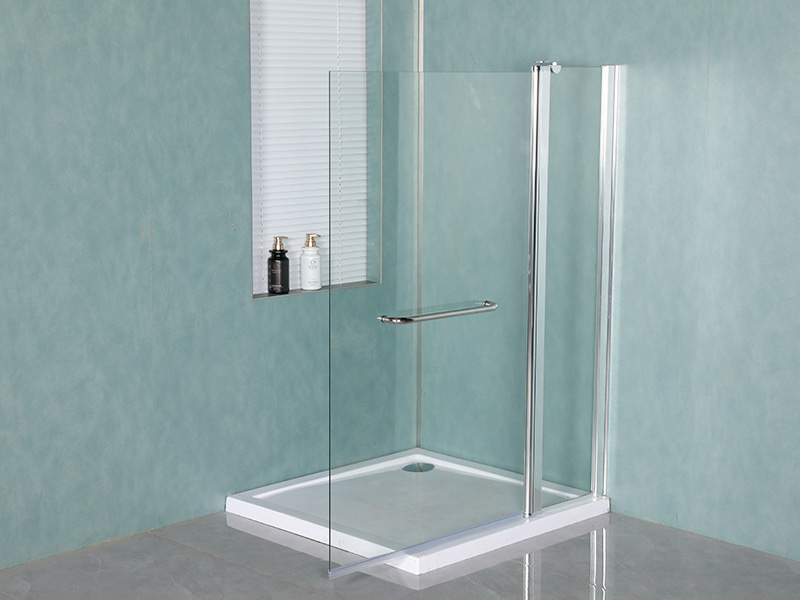
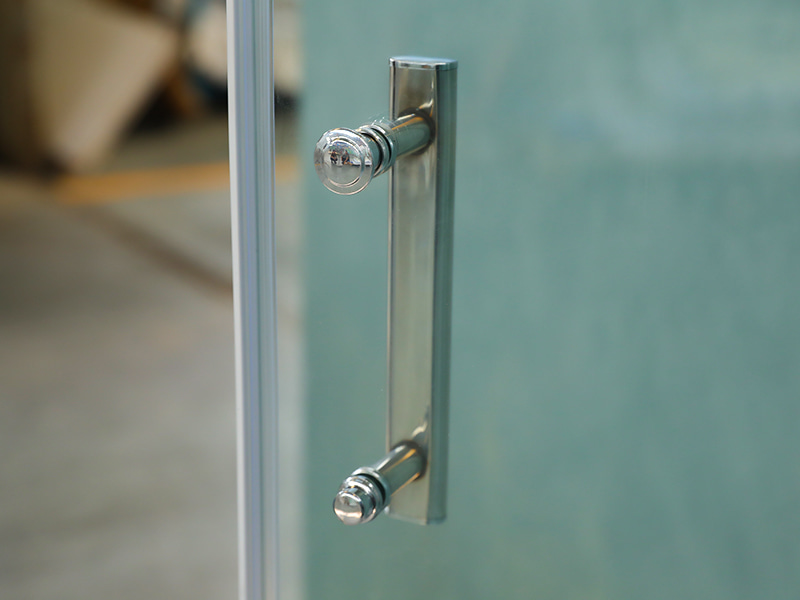 RSQ Pivot Shower Enclosure with Double-Holes HandleClear tempered glass, chrome aluminium profile and double-holes handle make this pivot enclosure worth checking where hinge and hole specifications must align.View Product →
Pivot and hinge doors concentrate stress at the drilled holes, so drill spacing, edge distance and bushing quality matter more than nominal thickness. Sliding systems spread load along a track but demand flatter panels, since a bow of a few millimetres shows up as a door that rubs at one end.
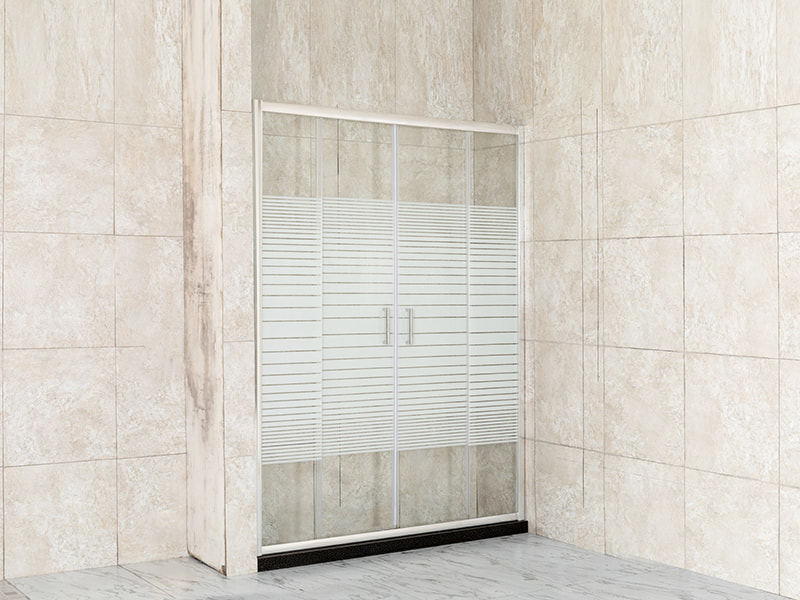
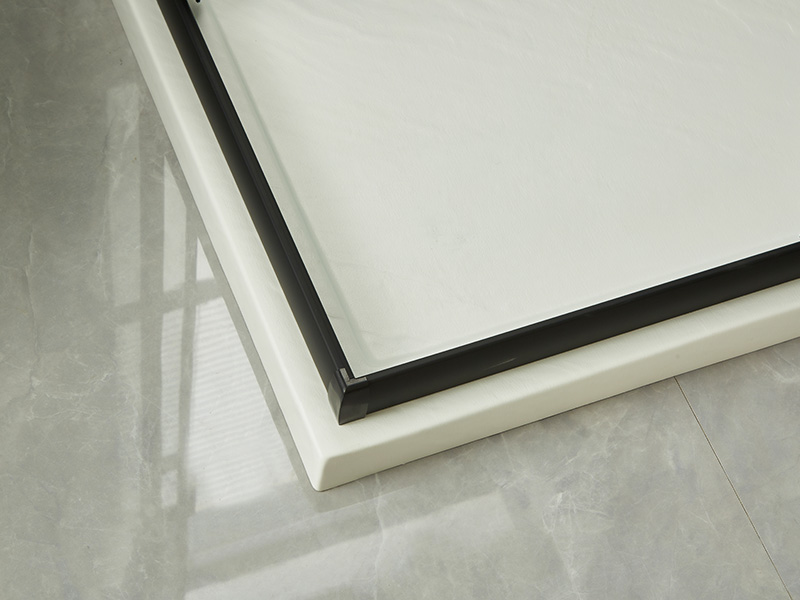 SQ Sliding Shower Enclosure with Black ProfileClear tempered glass, black aluminium profile, double-holes handle and matching tray suit this sliding enclosure where flat panels and track load distribution matter.View Product →
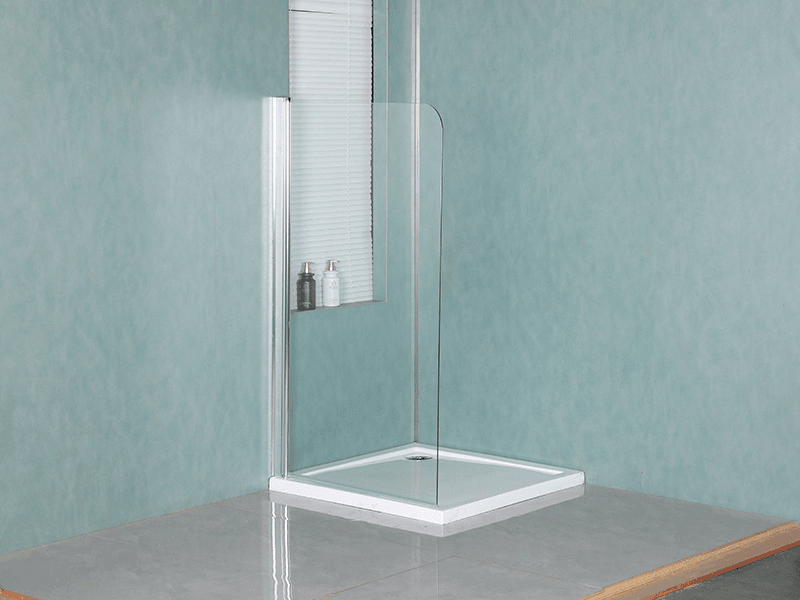
Walk-in panels carry no hardware at all, which makes edge polish and wall fixing the critical details instead. If a panel does break, the fracture pattern is diagnostic: small blunt fragments in the frame mean the glass was toughened and the cause was impact or edge damage, while long splinters suggest untreated glass. Our note on what to do when a shower screen cracks walks through the practical sequence.
A toughening furnace is expensive and easy to claim. A few documents and one factory observation separate a real line from a reseller.
On a factory visit, look at edge quality before the furnace and at the scrap bin after it. A line that polishes edges properly and reports its breakage rate openly usually understands exactly what toughening does to a panel.
Glass toughening rewards buyers who specify early and inspect late. Decide thickness, hole pattern, edge finish and standard before the purchase order is signed, then verify the batch with a fragmentation record and an edge check on arrival. A panel that turns up flat, correctly drilled and properly crated is not luck; it is the result of a process where every step happened in the right order.
Your email address will not be published. Required fields are marked *

 Tel: +86 13967167585
 E-mail: [email protected]
Copyright 2023 Anhui D-MAN Smart Home Co., Ltd. All Rights Reserved Shower Enclosures Manufacturers Shower Room Design Custom
