


 Français
 عربى
Product Consultation
Your email address will not be published. Required fields are marked *
Picture the moment a shower enclosure order goes wrong: the tiler has finished, the opening measures 1,190 mm instead of 1,200 mm, and the panels are already on site. With regular glass, someone can score and cut it in the workshop. With tempered glass, both panels are scrap, and a replacement means a new production run. That single difference explains most of the practical gap between the two materials.
The short answer: tempered glass is ordinary float glass that has been cut, drilled and edge-polished first, then heated to roughly 620–700 °C and quenched with high-pressure air. The quench locks the surfaces into compression and the core into tension, which makes the sheet about four times more resistant to impact and bending than regular glass of the same thickness. It also removes any possibility of cutting or drilling afterwards, and it changes how the panel fails — into small blunt granules rather than long sharp shards.
Content
Glass leaves the float line as annealed glass, the industry term for glass cooled slowly and evenly so it stays workable. Annealed glass can be scored, cut, drilled with a diamond bit and polished at the edges in any workshop, and it is the raw material behind both products in this comparison.
Tempering happens only after every cut, hole and edge detail is finished. The panels enter a roller furnace, are held at around 620–700 °C until they soften slightly, then pass into a quenching zone where air jets cool both faces in seconds while the core stays hot a little longer. As the core finally contracts, it pulls the surfaces tight. Finished sheets typically carry surface compression of at least 69 MPa (about 10,000 psi), the level referenced in EN 12150 in Europe, GB 15763.2 in China and comparable to the safety glazing requirements of ANSI Z97.1 and 16 CFR 1201 in the United States.
Two consequences follow directly from that sequence: the glass is stronger, and it is permanently unchangeable. There is no version of tempered glass that can be trimmed to fit later.
Impact and bending strength rise roughly fourfold compared with annealed glass of the same thickness. A 6 mm tempered panel absorbs blows that would leave a 6 mm annealed panel in pieces, which is why tempering is the default for shower doors, fixed side panels, partitions and any surface a shoulder, a bucket or a sliding door roller might strike.
The strength is not uniform, and three limits matter to anyone specifying it:
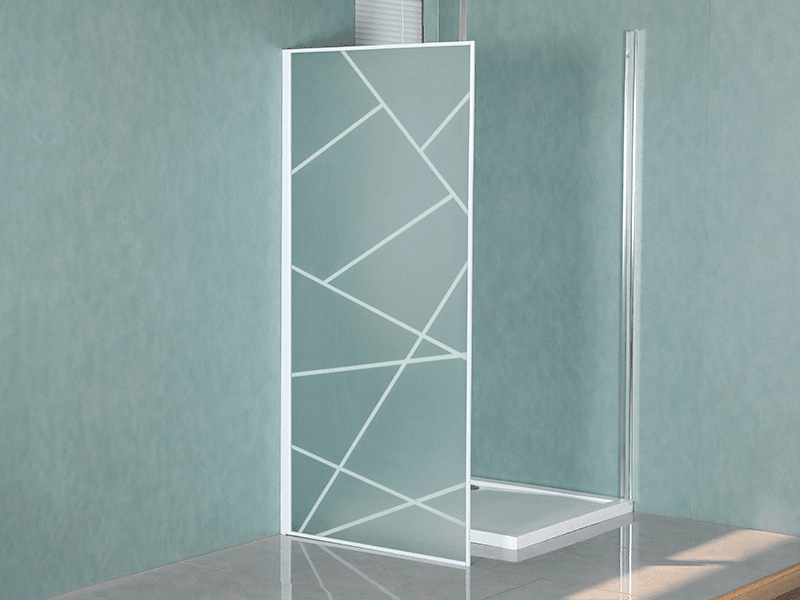
A working example of how that specification reads on a finished product: a black aluminium profile shower screen built around clear tempered glass with a printed pattern, where the profile colour, glass treatment and handle holes are all fixed before the glass is tempered.
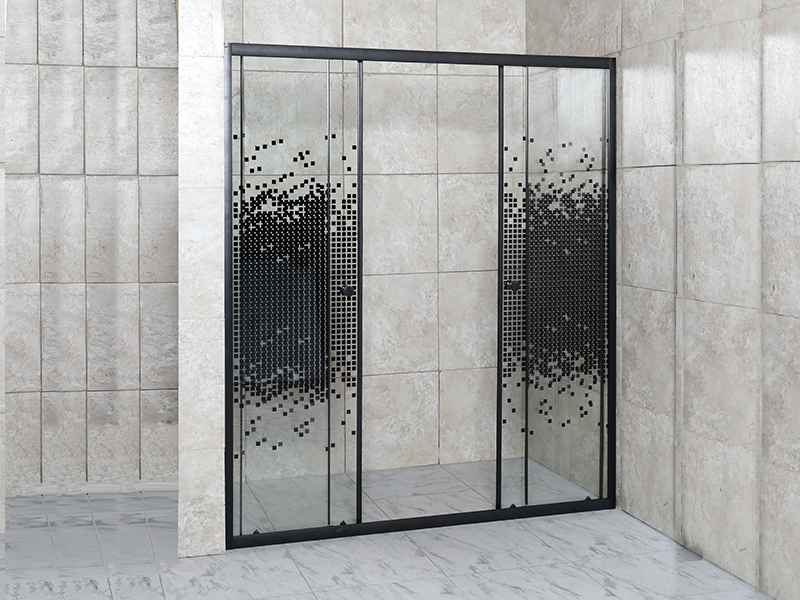 DD-1 Black Aluminium Shower Screen with Printed Tempered GlassA two-fixed, two-sliding enclosure with black profile and printed clear tempered glass, offering easy access and safer breakage behavior.View Product →
Regular glass breaks into large, dagger-shaped shards with sharp edges — the reason annealed glass is restricted in doors, low-level glazing and bathroom panels by most building codes. Tempered glass fractures into hundreds of small, roughly dice-shaped granules. They still cut, and they still need sweeping up, but the injury profile is far better and no blade-like piece drops out of the frame.
The failure mode also affects how a panel behaves in its frame. Once the stress envelope is breached, tempered glass usually disintegrates completely, so a damaged panel is replaced rather than repaired. If you are looking at a chip or hairline crack right now, the practical next steps are set out in this guide to a cracked or chipped shower screen.
One clarification worth keeping straight: tempering and lamination are different safety strategies. Tempering changes the breakage pattern; lamination holds the fragments together with an interlayer. Some high-end enclosures combine both.
Thermal shock is a real bathroom issue: hot water hitting cold glass, a heat lamp nearby, or sunlight falling across a dark-tiled enclosure. Annealed glass generally tolerates a surface temperature difference of only around 40 K before the induced stress exceeds its strength. Tempered glass handles a differential in the region of 200 K — roughly five times the headroom.
That margin is why tempering is specified near heat sources, and also why an annealed panel that survived mild conditions for years can fail on one cold morning when part of it sits in shade and part in sun.
| Property | Regular (annealed) glass | Tempered glass |
|---|---|---|
| Manufacturing | Cooled slowly on the float line; workable afterwards | Cut and drilled first, then heated to about 620–700 °C and air-quenched |
| Impact and bending strength | Baseline | Roughly four times the annealed value |
| Breakage pattern | Long, sharp shards | Small, blunt granules |
| Thermal shock tolerance | Around 40 K surface differential | Around 200 K surface differential |
| Cutting or drilling after production | Possible | Not possible — the panel shatters |
| Edge and hole sensitivity | Moderate | High; edge damage can cause delayed failure |
| Relative unit cost | Lower | Higher, plus remake cost if dimensions change |
| Typical bathroom use | Cabinet doors, shelves, decorative inserts | Shower doors, fixed screens, walk-in partitions, bath screens |
Thickness comes first. Six millimetres is adequate for fixed side panels, eight millimetres is the common choice for sliding and pivot doors because it resists flexing on rollers and hinges, and ten millimetres suits large walk-in panels with no frame along the top edge. Heavier is not automatically better — thicker glass needs stronger hardware and better wall fixings.
Second, decide when to measure. Because tempered panels cannot be adjusted, confirmed dimensions must come after tiling and after the tray is fixed. A 5 mm error that a carpenter hides in timber is a full replacement in glass.
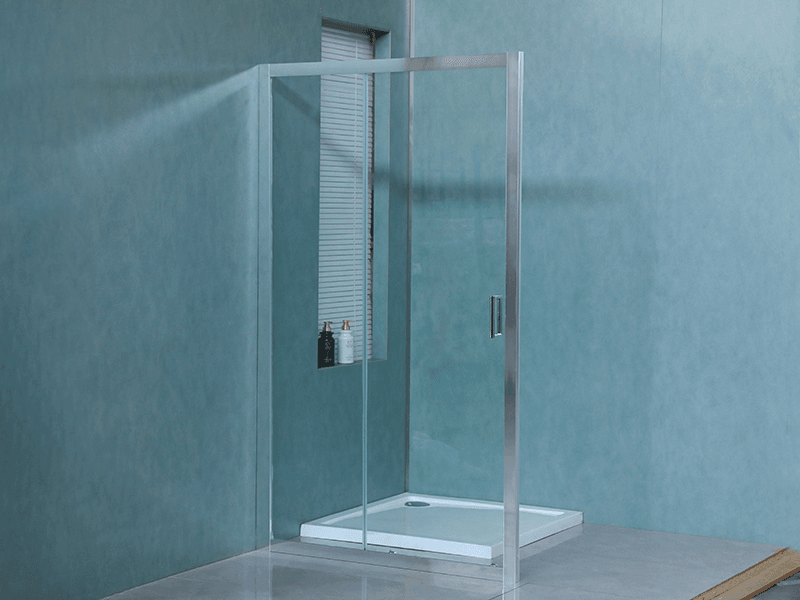
Third, lock the hole positions. Handle type, hinge spacing and door width are all drilled before tempering, so swapping a single-hole handle for a double-hole design means new glass rather than a new handle. Sliding configurations with an integrated tray are usually specified for retrofits where the floor is already level and the wall line is straight.
Pivot and opening enclosures suit smaller bathrooms, where a door that swings inward would collide with a basin or a towel rail; the pivot point and the panel width have to be settled at drawing stage for the same reason.
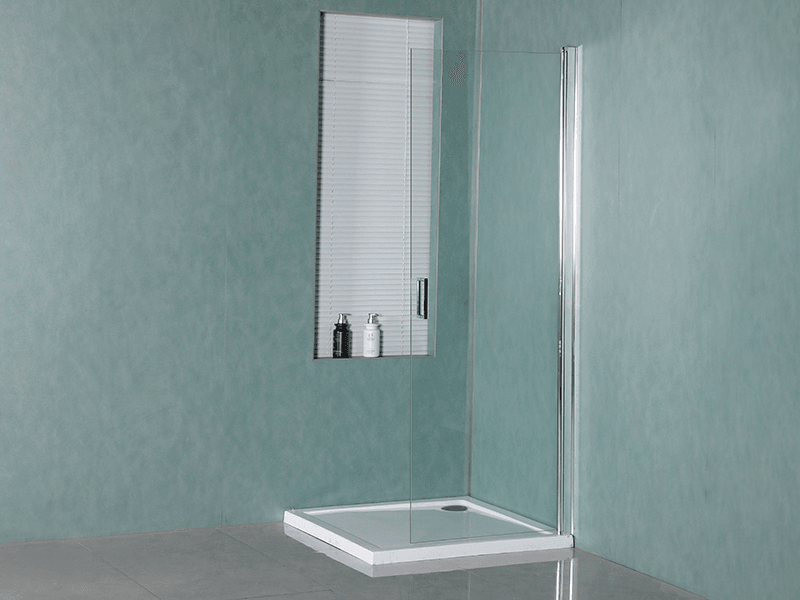
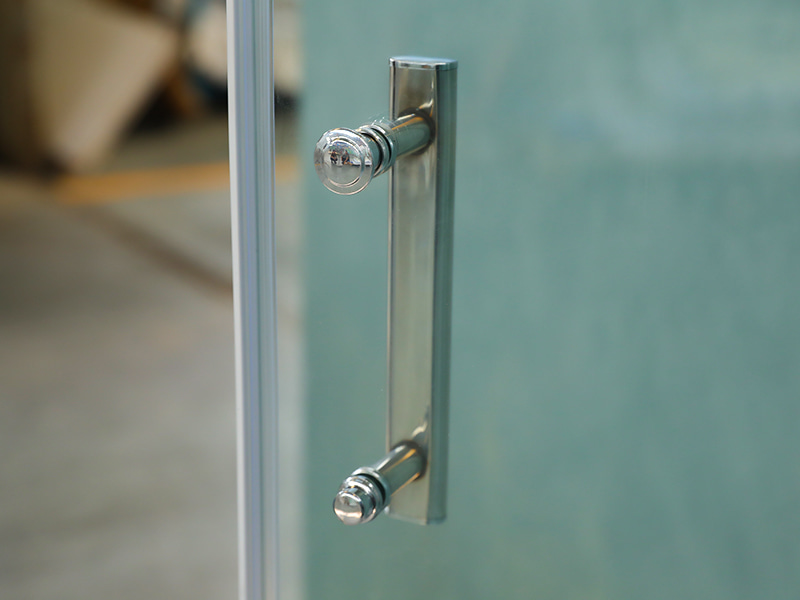 RSQ Pivot Shower Enclosure with Chrome Profile and Double-Holes HandleA clear tempered glass pivot enclosure with chrome aluminium profile, double-holes handle and shower tray, suited to smaller bathrooms.View Product →
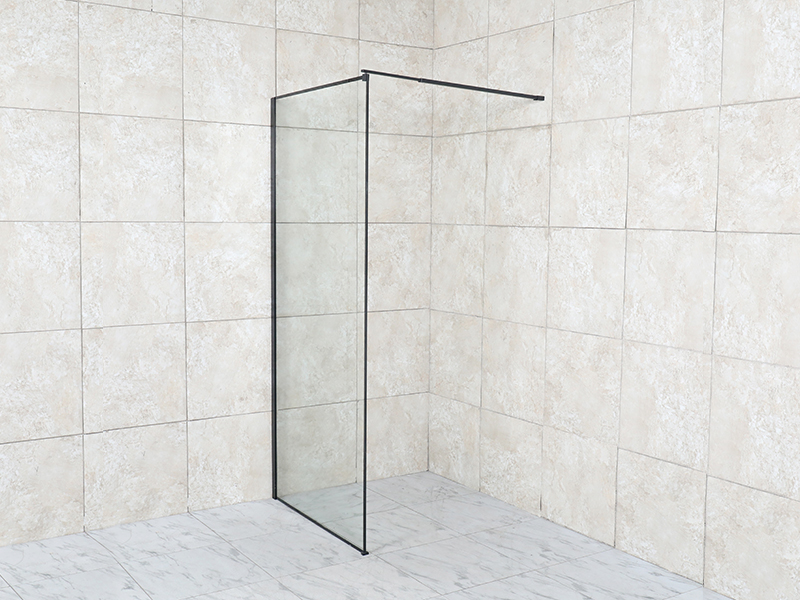
Fourth, agree tolerances in writing. Flatness and bow allowances in EN 12150 sit at roughly 0.3% of the shorter edge, and a little roller wave is normal. Inspect deliveries against those limits rather than against an idea of perfectly flat glass. Walk-in configurations without a door are the most demanding case, since the panel is often supported on one side only; the fixing method for walk-in shower enclosures deserves a separate drawing check.
Common procurement mistakes worth flagging:
The practical rule is simple. If the panel will be touched, leaned on, splashed with hot water or required to resist impact, specify tempered glass and finalise every dimension, hole and edge detail before production. If the glass will never be exposed and the opening may still change, annealed glass remains the cheaper, more forgiving option — right up until someone specifies it in a shower.
Your email address will not be published. Required fields are marked *

 Tel: +86 13967167585
 E-mail: [email protected]
Copyright 2023 Anhui D-MAN Smart Home Co., Ltd. All Rights Reserved Shower Enclosures Manufacturers Shower Room Design Custom
